
React vs Angular: Which One is Best for Your Front-end Development?
According to recent statistics, React.js is utilized by over 4.8% of all websites globally in 2025, and impressively, it's the technology behind more than 46% of the top 1000 websites.
Introduction
When it comes to building dynamic, user-friendly, and scalable web applications, choosing the right front-end framework is often the first big decision. Two of the most popular options—React vs Angular—have consistently dominated the developer landscape. While the React framework is celebrated for its flexibility and component-based architecture, the Angular framework stands out with its robust ecosystem and opinionated structure.
Businesses and developers alike weigh the benefits of Angular development against the versatility of React to determine which tool best suits their project needs. But the real question is—which one is best for your front-end development journey?
What is React?
React is an open-source JavaScript library from Facebook used for creating fast, interactive, and scalable user interfaces. Rather than handling full web pages, React works to build reusable UI components, making development simpler and applications more maintainable.
For React developers, one of its biggest advantages is the virtual DOM, which ensures high performance by updating only the necessary parts of a webpage. React's component-based architecture also promotes reusability and flexibility, allowing developers to create complex applications with ease.
In simple terms, if you're wondering what is React, it's a powerful tool that helps developers build dynamic, user-friendly applications while maintaining speed and efficiency.
Advantages of React
For web application development, companies and developers tend to look for a framework that combines performance, flexibility, and simplicity. ReactJS has become one of the top choices, due to its simplicity and large community support. Even novice developers wonder, "what's easier to learn: React or Angular?"—and React tends to win out due to its simplicity and reusable components.
For beginners and seasoned React developers alike, the library provides several advantages that make the development of React JS extremely efficient.
Most Important Benefits of ReactJS:
- Simple to Learn and Implement: Vis-à-vis other frameworks, React is easy to learn and implement, especially for beginners.
- Component-Based Architecture: Promotes reusability of code, saving time in development and enhancing maintainability.
- High Performance with Virtual DOM: React only updates the parts of the UI that need to be updated, making it render quickly and provide a better user experience.
- Strong Community and Ecosystem: With thousands of libraries, tools, and active React developers, resources and support are readily available.Ideal for Scalable Web Applications – React is optimised for projects from small websites to large-scale web application development.
Limitations React
Although the React framework is well-adopted and relied upon for contemporary app development, it is not without pitfalls. Most React developers appreciate its flexibility, but this same flexibility sometimes causes confusion, particularly for those who are new to the framework. Unlike full-fledged frameworks, React is a library that only deals with the view layer, which leaves developers having to trust third-party tools for routing, state management, and so on. For a front-end developer using React JS, it is crucial to know these gaps prior to embarking on a big web application project.
Important Limitations of React:
- Sloping Learning Curve for Beginners: React is simpler to begin, but advanced topics such as state management, hooks, and lifecycle methods can be difficult to learn.
- Too Many Options: Such a rich ecosystem leaves developers with more than one library to select from for activities like routing or global state, thus slowing down decision-making.
- Rapid Fire Updates: The React framework updates rapidly, and developers must stay current with new versions and continually adapt their skills.
- JSX Syntax Hurdle: Though powerful, JSX can seem alien to those with no prior experience in JavaScript, thus making the learning process more challenging.
- Not a Full Framework: As React only targets the UI layer, other libraries must be utilised to create fully functional web applications, which adds complexity.
What is Angular?
Angular is a powerful open-source framework maintained by Google, designed for building dynamic, single-page applications. If you're wondering what is Angular, it's a complete solution that provides everything from templates and routing to testing and data handling. Unlike libraries that focus only on specific parts of an application, the Angular framework offers a comprehensive approach, making it a popular choice among businesses and front-end developers. Its robust architecture, integrated utilities, and opinionated nature make Angular development particularly effective for enterprise applications and intricate Angular UI needs.
Limitations of Angular
Organisations prefer Angular development due to its ability to blend scalability with dependability. Its neatly organised ecosystem enables front-end developers to develop and support applications with utmost simplicity, and its pre-packaged tools reduce the necessity for third-party libraries.
Major Benefits of Angular:
- End-to-End Framework: In contrast to other libraries, Angular delivers everything an app builder requires, ranging from routing to testing, without overdependency on third-party utilities.
- Two-Way Data Binding: Self-synchronizes data between the view and the model, making it easy to develop interactive Angular UI applications.
- Strong Community & Google Support: Regular updates, manuals, and community support make it a solid bet for long-term projects.
- Excellent for Enterprise Solutions: Its methodical approach is most appropriate for big projects with complex workflows.
- Reusable Components & Modules: Accelerates development and improves maintainability for front-end developers.
React vs Angular: Feature Comparison
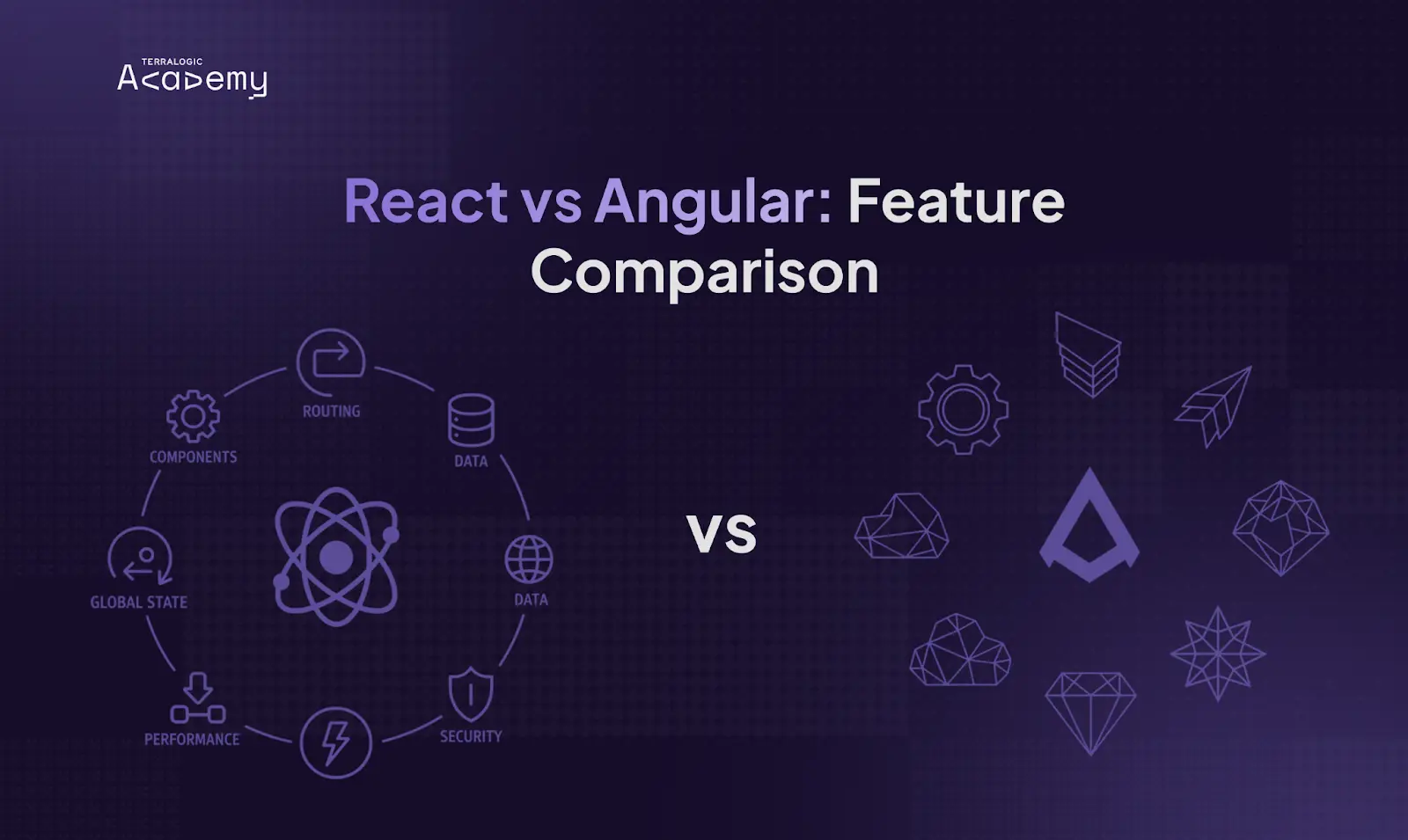
Both React and Angular are top picks for contemporary front-end development, but they handle web application development differently. React is appreciated for being simple and flexible, whereas Angular is renowned for having a structured, feature-complete framework.
React vs Angular at a Glance:
- React: A light-weight library centred around the view layer, best suited for building reusable components and dynamic UIs.
- Angular: An end-to-end frontend framework with built-in tools for routing, testing, and state management.
- React: More liberty by allowing developers to pick supporting libraries.
- Angular Offers an all-in-one solution with a more opinionated design.
- React: Used popularly by React developers for startups to large enterprise web applications.
- Angular: Used for Angular web development in enterprise applications needing complex workflows.
Which One Should You Choose?
The choice between React Vs Angular ultimately comes down to your project requirements and learning trajectory.
React: It is ideal if you desire a light, flexible solution. It offers the ability to decide on supporting libraries, making it ideal for startups, small to medium-sized web applications, and developers who want to customise their stack. It's also the easier choice for beginners, who often ask,"Which is easier to learn: React or Angular?"
Angular: It fits better if you like a structured, one-stop-shop ecosystem. It's highly dependable for Angular frontend projects and enterprise-level Angular web development with inbuilt tools for routing, testing, and state management. Though its learning curve is higher because of TypeScript and a stricter structure, it provides consistency in big teams and complex applications.
Therefore, if you are asking, "Should I learn React first or Angular?"?—begin with React for a faster introduction to front-end development, and proceed with Angular later if you're going to develop large-scale, enterprise-level applications.
Conclusion
Both React and Angular are powerful, but the right choice depends on your goals. If you are wondering, "Should I learn React first or Angular?" the answer often leans toward React, especially for beginners and small to medium-scale projects. Its simplicity and huge community make it easier to start and grow as a developer.
For those aiming at enterprise-grade solutions, Angular frontend remains a strong contender, offering a complete ecosystem for Angular web development. Ultimately, React continues to dominate because of its flexibility, strong ecosystem, and the vast number of React developers building innovative web applications worldwide.
All topics
-(1).png&w=3840&q=75)
They Tried This Beginner's Roadmap for a Full-Stack Developer That Actually Works

 HELP CENTER